
Christmas Day is usually associated with family, celebration and togetherness. But on December 25, 1929, the Lawson family of Germanton, North Carolina, became the victims of one of the most disturbing familicides in American history.
That afternoon, Charles Davis “Charlie” Lawson, a 43-year-old tobacco farmer, killed his wife and six of their seven children before taking his own life.
Only his eldest son, 19-year-old Arthur Lawson, survived.
More than 90 years later, the exact reason Charlie Lawson committed the murders remains uncertain. One of the most frequently discussed theories involves an alleged incestuous relationship between Lawson and his teenage daughter, Marie, although that claim was not documented publicly until decades after the killings.
The Lawson Family
Charlie Lawson married Fannie Manring in 1911. Together, they had eight children.
Their third child, William, died from an illness in 1920. In 1918, the family moved to the Germanton area of North Carolina after Charlie’s younger brothers, Marion and Elijah, had settled there.
The Lawsons worked as tenant tobacco farmers.
Their circumstances gradually improved, and by 1927 Charlie had managed to save enough money to purchase his own farm on Brook Cove Road.
To people around them, the family appeared to be living an ordinary rural life.
Then came Christmas 1929.
A Strange Christmas Outing
In the days before Christmas, Charlie took Fannie and their seven surviving children into town.
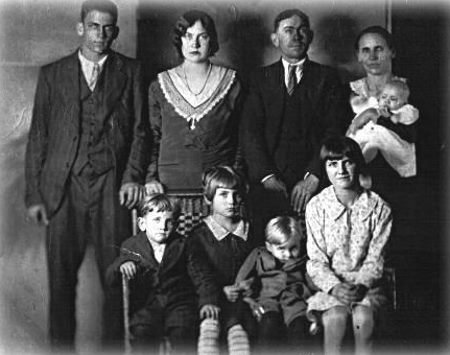
The family bought new clothes and had their photograph taken together.
At first glance, there was nothing obviously unusual about this. Charlie had recently become a landowner, and a special family shopping trip before Christmas was certainly possible.
But after the murders, people began looking back at that photograph and wondering whether Charlie had known that the family would not survive the holiday.
The picture would eventually become one of the most haunting reminders of the Lawson family.
The children shown with their parents were:
- Arthur, 19
- Marie, 17
- Carrie, 12
- Maybell, 7
- James, 4
- Raymond, 2
- Mary Lou, 4 months
Arthur was the only one who would survive.
Christmas Day
On the afternoon of December 25, Charlie Lawson began carrying out the murders.
His daughters Carrie and Maybell were leaving the property to visit their uncle and aunt when Charlie attacked them near the tobacco barn.
He then returned toward the house.
Fannie was outside when Charlie shot her.
Inside the house, Marie heard what had happened and screamed. The younger children, James and Raymond, attempted to hide, but Charlie found them.
The infant, Mary Lou, was also killed.
The details of the murders were horrific, but perhaps the most disturbing part of the crime was the fact that the victims were members of Lawson’s own family.
Afterward, Charlie went into the nearby woods.
Hours later, he took his own life.
Arthur had survived only because his father had sent him on an errand shortly before the killings began.
The Scene
When relatives and authorities arrived, the bodies of the victims had been arranged with their arms crossed and rocks placed beneath their heads.
The community had already begun gathering at the Lawson property after news of the killings spread.
Then a gunshot was heard from the woods.
A police officer who was with Arthur went searching for Charlie and found him dead near a tree.
Letters addressed to his parents were reportedly found with him.
Footprints around the tree suggested that Charlie may have walked around the area repeatedly before ending his own life.
The scene left investigators and the local community struggling to understand what could have driven a father to destroy his entire family.
What Was the Motive?
The motive has never been definitively established.
Over the decades, several explanations have been proposed.
One early theory focused on a head injury Charlie had suffered several months before the murders. Some people who knew him wondered whether the injury had changed his personality or affected his mental state.
However, an examination of his brain at Johns Hopkins Hospital reportedly found no abnormalities.
That left another, much darker theory.
The Rumors About Marie
For many years, there were rumors surrounding Charlie’s relationship with his 17-year-old daughter, Marie.
The claim that Charlie had sexually abused Marie did not become publicly documented until the publication of White Christmas, Bloody Christmas in 1990.
According to information later provided to the author, relatives had discussed concerns that there may have been an incestuous relationship between Charlie and Marie.
A friend of Marie’s, Ella May, later came forward with another disturbing allegation. She said that Marie had confided in her shortly before Christmas 1929 that she was pregnant by her father.
Because these claims emerged decades after the murders, they have remained part of the case’s mystery rather than an established explanation.
Another Lawson family friend and neighbor, Hill Hampton, reportedly acknowledged that he knew there were serious problems within the household but did not explain what those problems were.
Some researchers have suggested that Charlie may have killed his family to conceal the alleged abuse and possible pregnancy.
But there is no definitive evidence establishing that as the reason for the murders.
The Family Photograph
The photograph Charlie had taken with his family shortly before Christmas became one of the most enduring images connected to the case.
It showed the Lawsons together shortly before six members of the family were killed.
The fact that Charlie had deliberately taken his family into town for new clothes and a portrait has fueled speculation that the murders had been planned.
At the same time, there is no conclusive proof that the photograph was intended as some kind of final family portrait.
It may simply have been a Christmas tradition for a family that had recently achieved greater financial stability.
That uncertainty is part of what makes the Lawson case so haunting.
A Grisly Tourist Attraction
In the aftermath of the murders, Charlie’s brother Marion Lawson opened the family home on Brook Cove Road to visitors.
People came to see the place where the killings had occurred.
Even a cake that Marie had baked on Christmas Day became part of the attraction.
Visitors reportedly picked raisins from the cake and kept them as souvenirs. Eventually, the cake was placed inside a covered glass container to protect it.
The Lawson property became an early example of what would now be called dark tourism.
The public fascination with the case did not disappear with time.
The Story Lives On
The Lawson murders became part of American folklore and inspired songs, stories and later documentaries and television programs.
In 1930, the Carolina Buddies recorded the murder ballad The Murder of the Lawson Family for Columbia Records.
The Stanley Brothers later recorded their own version in 1956.
The case was also examined in an episode of the podcast Criminal and later appeared in Netflix’s 28 Days Haunted.
The Lawson family grave remains another physical reminder of the tragedy.
What Happened to Arthur?
Arthur Lawson, the family’s only surviving child, eventually built a life of his own.
He married and had four children.
But he carried the memory of what happened to his family for the rest of his life.
In 1945, Arthur was killed in a motor vehicle accident at the age of 35.
By then, the Christmas Day massacre had already become one of North Carolina’s most infamous unsolved mysteries of motive.
A Christmas That Was Never Forgotten
The Lawson family murders happened nearly a century ago, yet the questions surrounding them remain.
Why did Charlie Lawson kill his wife and children?
Was the crime carefully planned?
Did his head injury have anything to do with his actions?
And were the later allegations concerning Marie actually the reason he committed the murders?
There are theories, rumors and accounts from people connected to the family, but no explanation has ever been conclusively proven.
What is certain is that on December 25, 1929, a family that had gathered together for Christmas was destroyed by the actions of its own father.
Six children and their mother lost their lives.
Arthur survived, but eventually died decades later.
The Lawson family story continues to attract attention because of its unanswered questions — but beneath all the theories and folklore is a much simpler tragedy: a family whose lives ended on Christmas Day, leaving behind a mystery that has endured for generations.
This story is based on publicly available information and reported facts. It has been independently written and presented for informational purposes. Images, if any, belong to their respective owners.

Leave a Reply