
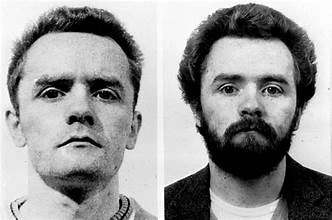
During the 1980s, a series of violent attacks around railway stations in southern England left women and children terrified. The offenders became known as the “Railway Rapists”, and later, after murders were committed, the “Railway Killers.”
At the center of the investigation were two friends from North London: John Francis Duffy and David Mulcahy.
The pair were eventually convicted of multiple murders and rapes, but it took years of investigation, new forensic technology, and a remarkable series of confessions before the full extent of their crimes became known.
A Pattern Begins
Duffy and Mulcahy had known each other since their school days at Haverstock School in North London.
Their friendship would eventually become linked to one of Britain’s most notorious criminal investigations.
In 1982, a woman was attacked and raped by two men near Hampstead Heath railway station. During the following year, numerous other women were assaulted, often late at night in isolated locations around North London.
Further attacks continued in 1984. Then, in 1985, three women were raped on the same night in Hendon.
The growing number of attacks forced police to launch an urgent investigation known as Operation Hart.
Victims described two attackers: one was shorter and had ginger hair, while the other was larger.
At the time, investigators did not have DNA technology. Blood-group evidence could eliminate some suspects, but it could not identify an offender with certainty.
The investigation therefore faced an enormous challenge.
The First Murder
On 29 December 1985, 19-year-old Alison Day was traveling to meet her boyfriend near Hackney Wick station.
Duffy and Mulcahy had been driving between railway stations when they encountered her after she left a train.
After making a telephone call, Day apparently took a wrong route and ended up near the canal, where the two men approached her.
She was threatened with a knife and sexually assaulted.
The attackers then forced her toward a railway bridge. Day fell into the canal but survived the fall and managed to reach the bank.
The men pulled her from the water and took her to nearby wasteland, where she was strangled.
Her body was then weighted down and placed in the River Lea.
The murder led to a separate investigation, Operation Lea, while police intensified their efforts to identify the men responsible.
Another Victim
The investigation took an even darker turn in April 1986.
On 17 April, 15-year-old Dutch schoolgirl Maartje Tamboezer was attacked in West Horsley, Surrey.
She had been riding her bicycle when she was knocked down after a wire had been stretched between two trees.
Tamboezer was raped and strangled. She had also suffered severe head injuries, and her body was set on fire.
Her murder resulted in another investigation, Operation Bluebell.
Detective Superintendent Charles Farquhar began looking closely at the similarities between the different crimes. Details from the crime scenes suggested that the cases might be connected.
Then, on 18 May 1986, 29-year-old secretary Anne Lock disappeared after getting off a train at Brookmans Park railway station in Hertfordshire.
She was abducted and murdered.
The three murder investigations were eventually brought together under Operation Trinity, creating one of the earliest major investigations involving several police forces and the use of early computerized investigative systems.
A New Approach to Finding the Killer
Police eventually began focusing on John Duffy.
Duffy had worked as a railway carpenter and had experience with martial arts. He was also already known to police because he had previously faced an allegation involving the rape of his estranged wife.
Investigators found unusual material known as somyarn at his parents’ home, which connected him to the investigation.
His familiarity with railway systems and his knowledge of tools also appeared significant to detectives studying the unusual methods used in the attacks.
Mulcahy was questioned because of his close association with Duffy, but investigators initially lacked enough evidence to charge him.
The victims, understandably traumatized by what they had experienced, were unable to identify him during an identification procedure.
He was released.
But the investigation was about to enter new territory.
The Birth of Criminal Profiling
Police brought in psychologist David Canter from the University of Surrey.
Canter examined the locations, circumstances and behavioral patterns surrounding the crimes. His work attempted to determine characteristics of the person responsible for the attacks.
This was a relatively new approach in Britain at the time.
Canter’s analysis eventually became an important part of what would later be known as investigative psychology.
His work provided investigators with another way of looking at the offender—not simply through physical evidence, but through patterns in behavior and geography.
Duffy Is Arrested
By this point, Duffy had also begun committing sexual assaults without Mulcahy.
On 26 November 1986, police arrested him after he was found following a woman in an isolated park.
Investigators discovered evidence connecting him to the Tamboezer murder, while several victims identified him as their attacker.
Duffy was charged with murders and rapes.
Police were convinced that he had not acted alone, but Duffy refused to identify his accomplice.
Mulcahy was again considered a suspect, although investigators still lacked sufficient evidence to charge him.
Conviction and a Troubling Revelation
Duffy went on trial in February 1988.
He was convicted of two murders and four rapes. However, he was acquitted of the rape and murder of Anne Lock.
The judge imposed a minimum term of 30 years, and that sentence was later changed to a whole-life tariff.
Duffy did not appeal.
But after his conviction, he began revealing something investigators already suspected: there had been another man involved.
At first, he refused to provide further details.
Years would pass before he finally began giving police a complete account.
The Confessions
By 1995, an officer who had worked around the original investigation was able to begin pursuing the case further.
Duffy agreed to a series of interviews.
Eventually, with help from the prison psychological service, he began making detailed admissions.
In 1998, he agreed to provide full accounts of the crimes.
The interviews were conducted under police caution and recorded.
Duffy confessed to numerous rapes and eventually remembered additional cases when investigators presented him with information from their archives.
He repeatedly identified David Mulcahy as his accomplice.
Duffy ultimately admitted involvement in all three murders and explained what he claimed had happened to Anne Lock.
He also described how he and Mulcahy had prepared themselves before attacks, including listening to Michael Jackson’s Thriller in their car.
His later admissions dramatically changed the investigation.
The Case Against Mulcahy
Police began closely tracking Mulcahy.
In February 1999, he was arrested.
This time, investigators had something they had not possessed during the original investigation: DNA technology.
DNA testing provided evidence linking Mulcahy to the crimes, while a search of his home produced additional evidence.
Mulcahy denied the allegations and maintained that Duffy was lying.
Duffy was eventually called to testify against his former friend.
His testimony lasted for 14 days and provided the prosecution with a detailed account of the crimes.
It was an extraordinary moment in the case: a convicted prisoner was giving evidence against his alleged accomplice.
Mulcahy’s Conviction
Mulcahy’s trial began at the Old Bailey in September 2000.
The prosecution presented him as a central figure in the murders and sexual assaults.
The defense rejected the allegations, arguing that Duffy was unreliable and that the forensic evidence had been manipulated.
The jury ultimately rejected those arguments.
In February 2001, Mulcahy was convicted of three murders and seven rapes.
He received three life sentences, along with a 30-year recommendation, and additional prison terms for the rape convictions.
Duffy later received additional sentences for seven rape offenses he had confessed to, although he was already serving a life sentence.
A Wider Investigation
The convictions raised another disturbing possibility.
If Duffy and Mulcahy had committed the known crimes, investigators wondered whether they might also have been responsible for other unsolved attacks.
Police therefore reopened investigations into hundreds of unsolved rape and murder cases across Britain.
Detective Superintendent Andy Murphy publicly suggested that Mulcahy could have been responsible for additional violence, either alone or alongside Duffy.
Surviving victims were encouraged to come forward.
However, despite the extensive review, neither man was ultimately charged with additional crimes beyond those already established.
The Legacy of the Railway Killers
The case had a lasting impact on British policing.
David Canter’s psychological work demonstrated how behavioral and geographical patterns could assist investigators, helping investigative psychology become a more established tool.
The case also demonstrated the enormous difference DNA technology could make. Evidence that had been unavailable during the original investigation eventually helped establish Mulcahy’s involvement years later.
John Duffy and David Mulcahy became permanently associated with the railway attacks of the 1980s.
Their crimes began with a pattern of sexual assaults around railway stations and eventually escalated into murder.
What initially appeared to be a series of separate crimes was ultimately revealed as a much larger investigation involving multiple police forces, early computer-assisted investigative methods, psychological profiling, confessions and, eventually, DNA evidence.
The full truth took years to emerge—but when it did, it revealed one of Britain’s most disturbing criminal partnerships of the era.
This story is based on publicly available information and reported facts. It has been independently written and presented for informational purposes. Images, if any, belong to their respective owners.

Leave a Reply